Featured Project
Navigating Workplace Conduct
A scenario based eLearning experience designed to help managers navigate unclear workplace conduct concerns. Using real world situations, learners explore how small decisions can shape team culture, trust, and compliance outcomes.
Responsibilities
- Instructional Design
- eLearning Development
- Visual Design
- Prototype Creation
Tools Used
- Storyline 360
- MindMeister
- Canva
- Microsoft Suite
Type
Concept Project
Audience
New and mid level marketing managers responsible for responding to employee concerns who may lack confidence handling situations that require judgment, discretion, and balanced decision making.
The Problem
At Northbridge Marketing Group, a fictitious marketing corporation, managers are responsible for leading collaborative teams in a fast-paced environment. In these settings, workplace conduct concerns can arise during everyday interactions.
These situations are not always clearly defined as policy violations, making them difficult for managers to address. As a result, managers may incorrectly handle these issues, increasing the risk to the organization and impacting team performance. Despite this, many training courses focus primarily on policy awareness rather than preparing managers to navigate these tricky, real world situations.
Solution
To solve the problem, I designed a scenario based eLearning experience that allows managers to practice responding to workplace conduct concerns in a realistic, low risk environment.
I determined that scenario based eLearning was the best solution because:
- The learner must make decisions and observe direct consequences of their actions
- Each decision reflects different situations that managers may encounter in their positions
- The learning experience is easily scalable and can be completed in various work environments (in-person, hybrid, remote)
- Learners may revisit the material, and the material can be adapted to different departments and management levels, making it a cost-effective solution
- In a real world implementation, this experience could be further supported by follow-up resources or manager coaching to reinforce behavior change over time
My Process
Action Mapping
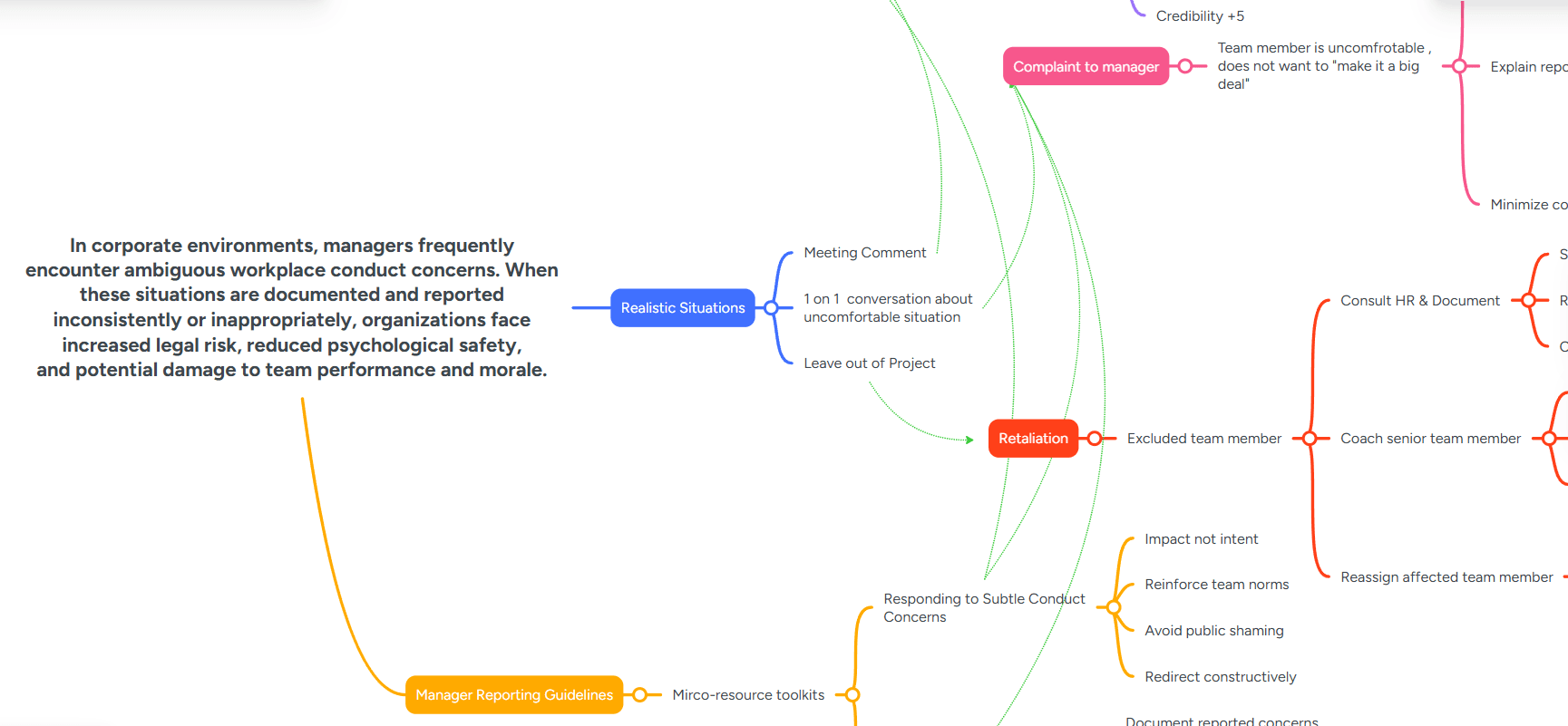
I began by identifying the core performance problem and mapping out realistic workplace scenarios where managers must make decisions. I then explored the potential consequences, focusing on their impact on psychological safety, organizational risk, and team dynamics. From there, I identified the key behaviors that managers need to practice, ensuring that each interaction reinforces effective decision making in ambiguous, real world situations.
Text Based Storyboard
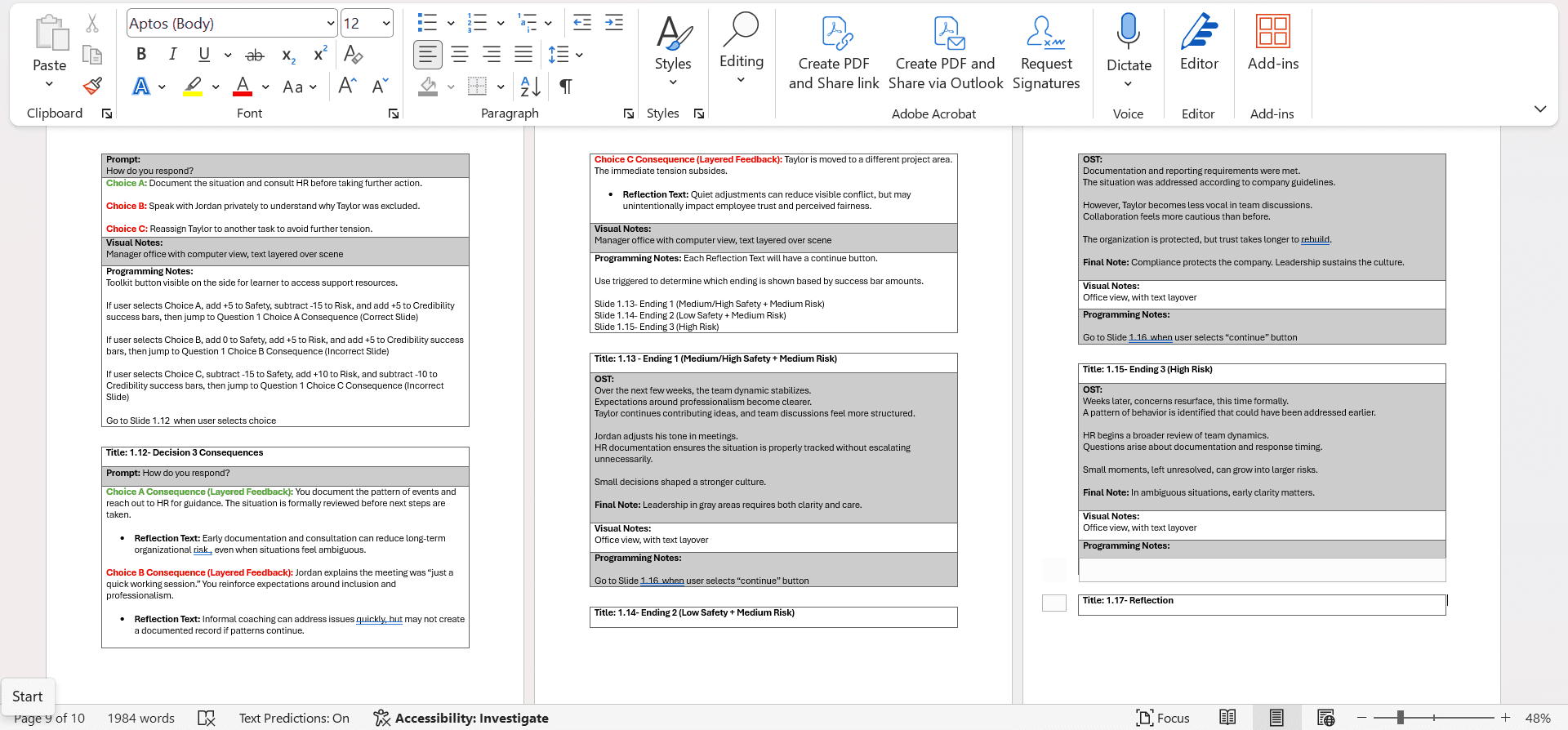
After identifying the key decision points, I created a detailed storyboard to map out the learner experience. I wrote each scenario using natural, conversational dialogue to reflect realistic workplace interactions. At each decision point, learners choose how to respond and experience the consequences as the scenario unfolds. I also incorporated a "Manager Toolkit" that provides optional guidance, allowing learners to access support as needed while still encouraging independent decision making.
Visual Mockups
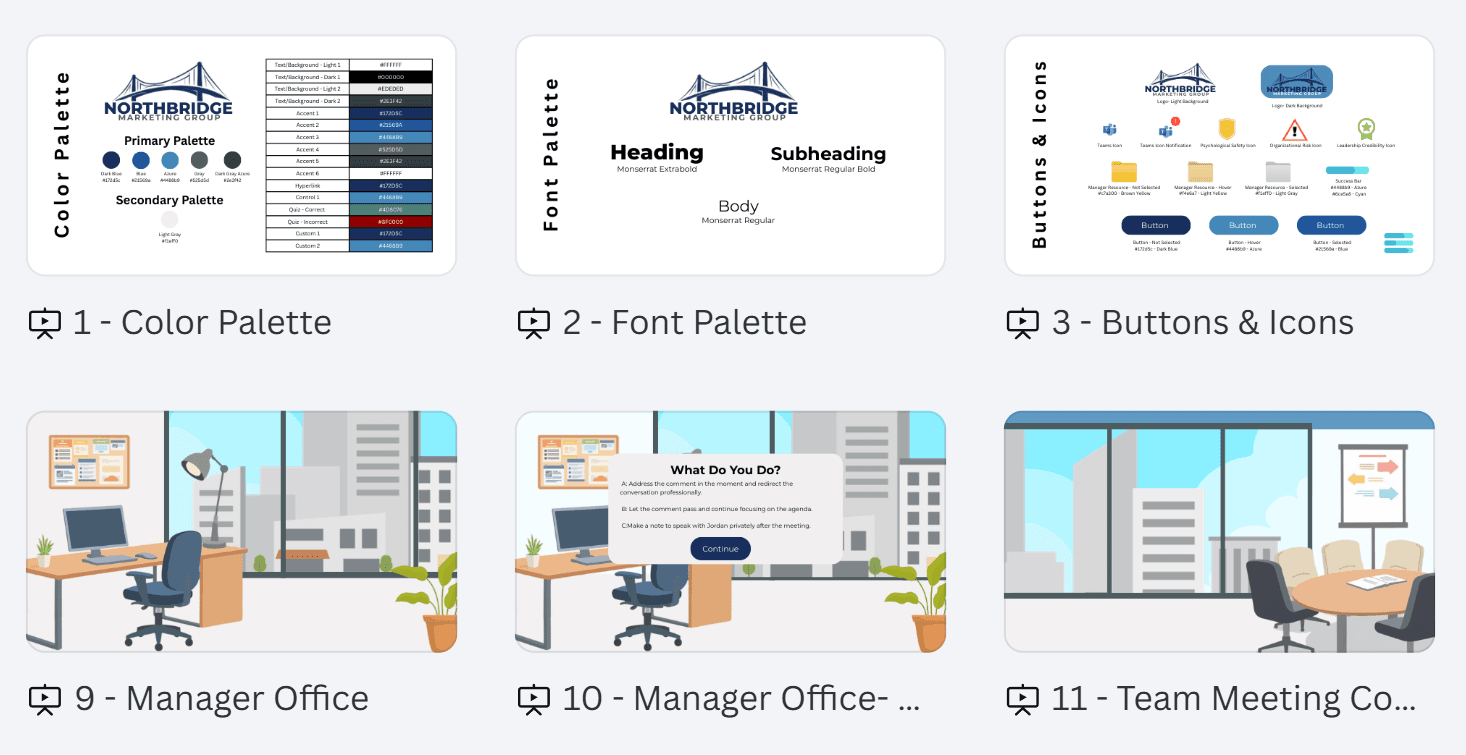
Using Canva, I developed the overall layout, style guide, and background mockups to establish a cohesive visual direction. I then implemented the interface in Articulate Storyline with a custom layout that feels more like a workplace environment than a traditional eLearning course, including a manager dashboard, progress indicators, and a persistent Manager Toolkit.
Prototyping
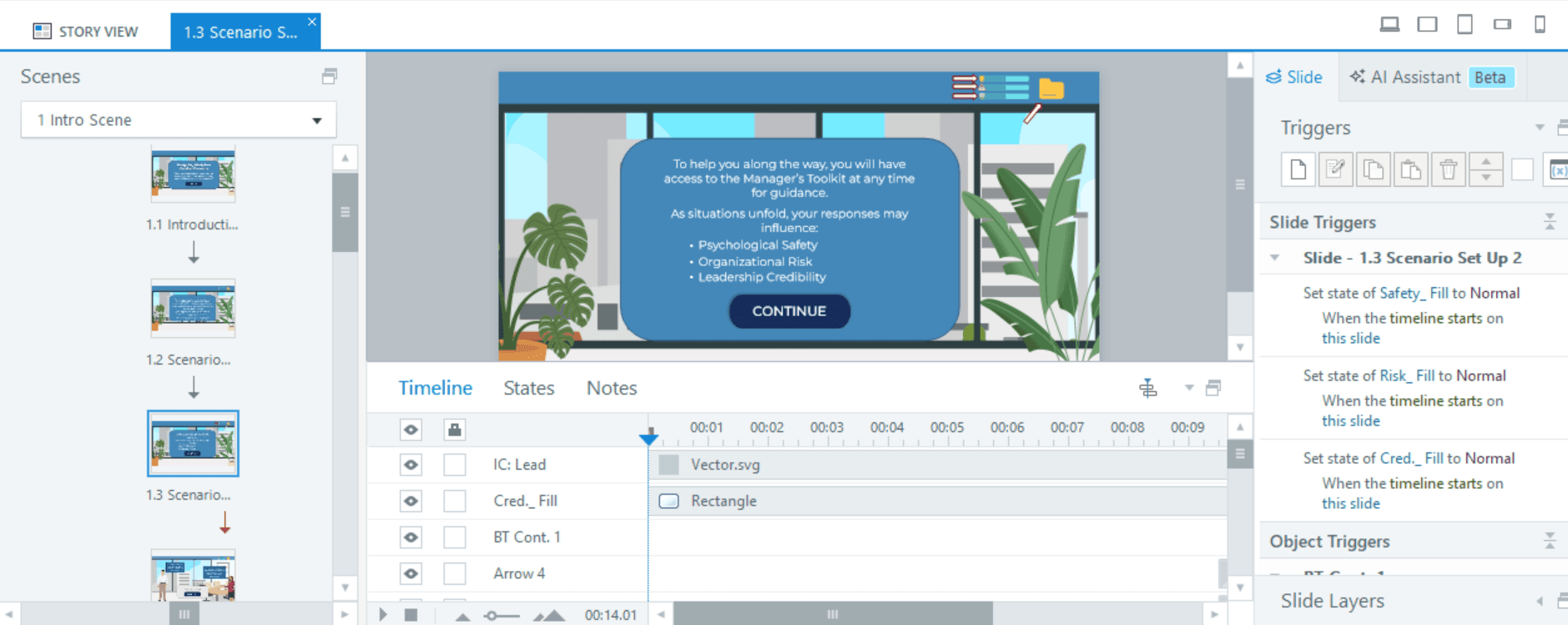
I developed an interactive prototype to test the flow, functionality, and overall user experience, building core interactions including branching decision points, variable driven progress indicators, and layered feedback. Throughout prototyping, I tested the experience to refine navigation, improve pacing, and ensure a smooth and intuitive user experience.
Development
After incorporating feedback from the interactive prototype, I moved into full development in Articulate Storyline. I refined the interactions, finalized visual elements, and ensured all variables, triggers, and branching logic functioned as intended, polishing transitions and pacing to create a seamless and engaging learner experience.
Results
This project demonstrates my ability to apply the ADDIE model to design a performance focused learning experience from analysis through evaluation. By grounding the experience in real world decision making, I was able to move beyond knowledge based training and focus on observable behaviors.
The design supports multiple levels of the Kirkpatrick Model. At Level 1 (Reaction), the immersive format is intended to increase engagement and relevance. At Level 2 (Learning), learners practice decision making and receive immediate feedback. At Level 3 (Behavior), the Manager Toolkit mirrors on the job performance support to bridge the gap between learning and real world application.
If implemented in a real world setting, this solution could be evaluated using learner decision patterns, completion rates, time spent on key interactions, and follow up assessments to measure behavior change over time.
Takeaways
Managing this project end to end strengthened both my instructional design and eLearning development skills. Working through each phase of ADDIE reinforced the importance of thoughtful planning, iterative design, and continuous refinement throughout the process.
One key takeaway was the value of designing for performance rather than information. By focusing on real world decisions and consequences, I was able to create a more meaningful and engaging experience that better reflects the complexity of workplace situations. Creating a cohesive interface, including custom layouts, progress indicators, and a persistent Manager Toolkit, required careful attention to detail and reinforced the importance of investing time in the analysis and design phases.